
The Paradise Named NIGERIA
A Book and a Movement: Navigating the Pathway to a United, Prosperous and Righteous Nation
- …

The Paradise Named NIGERIA
A Book and a Movement: Navigating the Pathway to a United, Prosperous and Righteous Nation
- …

Get your copy by visiting the store on this site or go to amazon.com
Building a United, Prosperous, and Righteous Nation
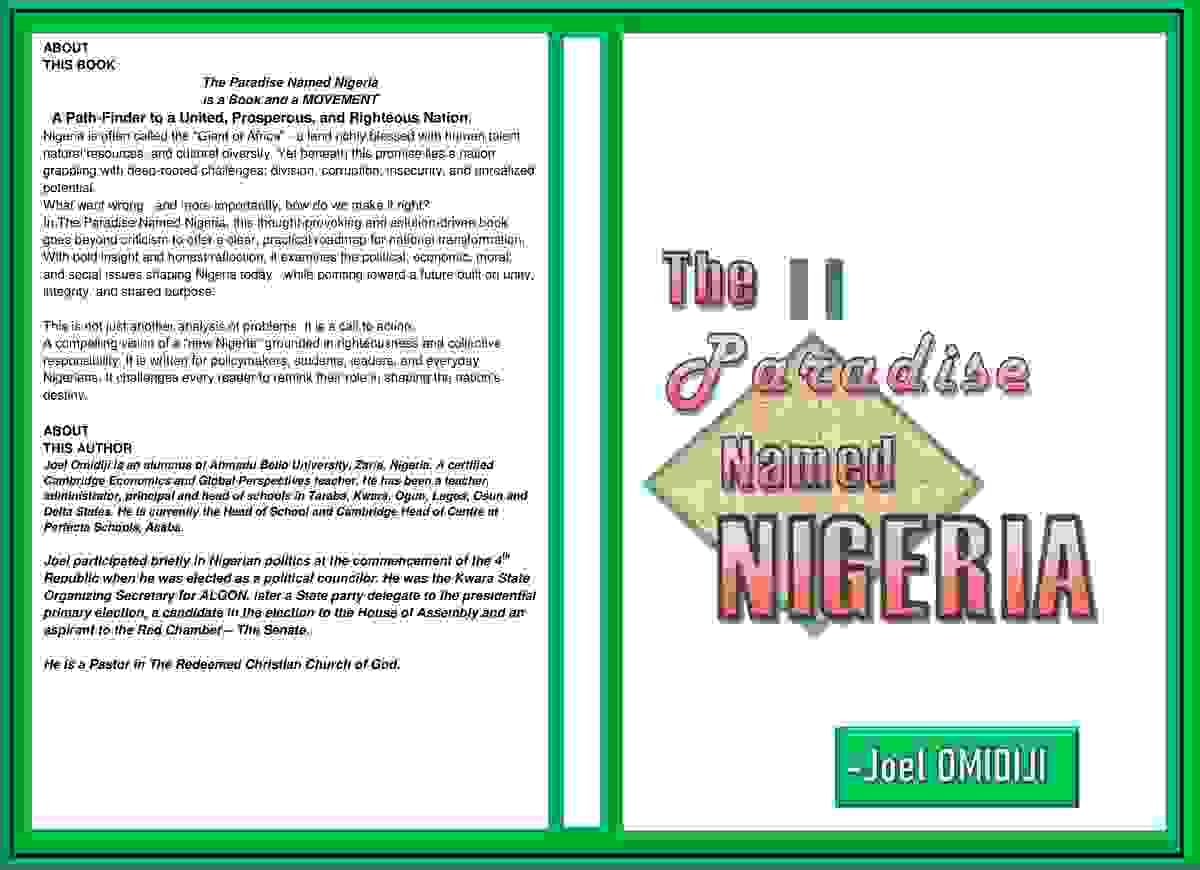
THIS BOOK IN A DETAILED GUIDE in THE ACT OF NATION BUILDING
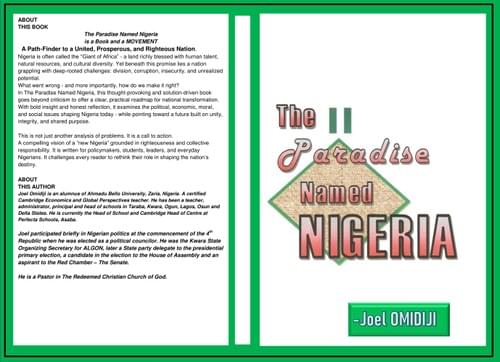
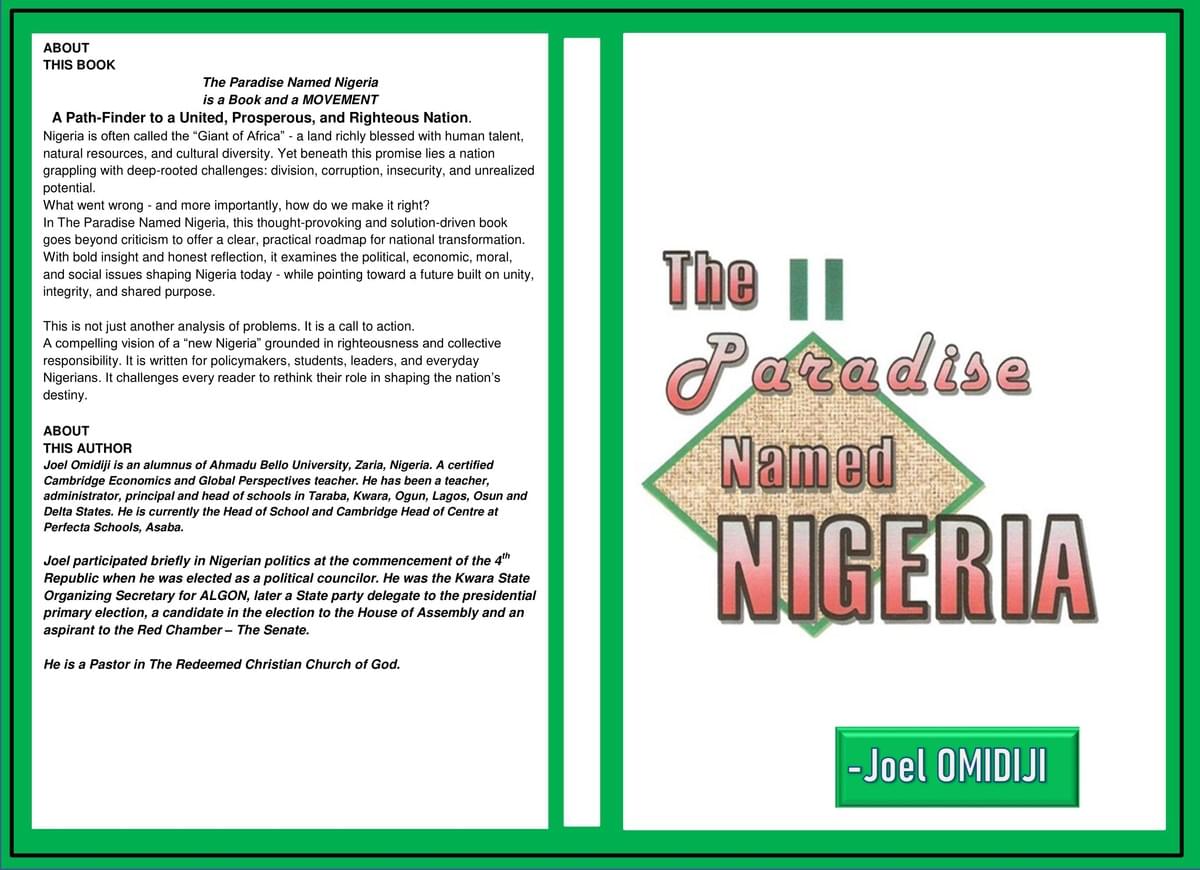
ABOUT THE BOOK
The Paradise Named Nigeria
is a Book and a MOVEMENT
A Path-Finder to a United, Prosperous, and Righteous Nation.
Nigeria is often called the “Giant of Africa” - a land richly blessed with human talent, natural resources, and cultural diversity. Yet beneath this promise lies a nation grappling with deep-rooted challenges: division, corruption, insecurity, and unrealized potential.What went wrong - and more importantly, how do we make it right?
In The Paradise Named Nigeria, this thought-provoking and solution-driven book goes beyond criticism to offer a clear, practical roadmap for national transformation. With bold insight and honest reflection, it examines the political, economic, moral, and social issues shaping Nigeria today - while pointing toward a future built on unity, integrity, and shared purpose.
This is not just another analysis of problems. It is a call to action.
A compelling vision of a “new Nigeria” grounded in righteousness and collective responsibility. It is written for policymakers, students, leaders, and everyday Nigerians. It challenges every reader to rethink their role in shaping the nation’s destiny.ABOUT THE AUTHOR
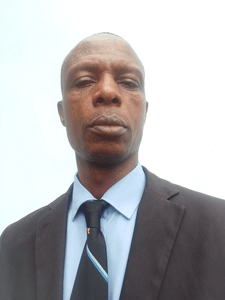
Joel Omidiji is an alumnus of Ahmadu Bello University, Zaria, Nigeria. A certified Cambridge Economics and Global Perspectives teacher. He has been a teacher, administrator, principal and head of schools in Taraba, Kwara, Ogun, Lagos, Osun and Delta States. He is currently the Head of School and Cambridge Head of Centre at Perfecta Schools, Asaba.
Joel participated briefly in Nigerian politics at the commencement of the 4th Republic when he was elected as a political councilor. He was the Kwara State Organizing Secretary for ALGON, later a State party delegate to the presidential
primary election, a candidate in the election to the House of Assembly and an aspirant to the Red Chamber – The Senate.
He is a Pastor in The Redeemed Christian Church of God.Excerpts from THE PARADISE NAMED NIGERIA
Prologue
Nigeria is not a poor country. It is not an unlucky country. It isnot even a hopeless country. And yet, it is a country where millions wake up
each day to darkness - sometimes literal, often systemic. A nation where potential is abundant, but progress is inconsistent. A place where brilliance
thrives in individuals but struggles to survive in systems. This is the
contradiction. Nigeria should have been a paradise. Not by fantasy, but by every measurable advantage: vast natural resources, one of the largest populations in the world, a strategic global position, and a people whose ingenuity has proven itself across continents. Wherever Nigerians go, they build, they lead, they excel. But within Nigeria itself, the story is different -frustratingly different.
So what went wrong?
Was it history?
Was it leadership?
Was it division?
Or was it something deeper - something we have refused to confront?
This book does not pretend that Nigeria’s problems are simple. They are layered, historical, and often uncomfortable to examine. But they are not mysterious. And more importantly, they are not permanent. Because nations do not fail by accident. They fail by patterns. And if patterns can be understood, they can be broken.
“The Paradise Named Nigeria” is not a celebration of what is. It is an examination of what could have been - and what still can be. It is a journey through promise, failure, and possibility. A confrontation with hard truths, but also a refusal to surrender to cynicism. This is not just a story about a country. It is a question directed at its people: What kind of nation do we truly want - and what are we willing to do to build it?...To buy the book, complete the form below and submit it.
Publications
The Paradise Named Nigera
- Read the FULL LENGTH OF CHAPTER ONE free of charge
You can buy the book on amazon. Simply click on the following link to get copies:
https://a.co/d/0clQT5Cc
You may also visit the store on this website or send text to 09130280429 to place your order- Especially if you reside in Nigeria.
Chapter 1 – The Gift of the Land
Nigeria Was Never Poor in Potential
Before there was disappointment, there was promise. Long before policy
failures, corruption scandals, or economic instability became part of Nigeria’s
global image, there was something simpler and more fundamental: a land of
extraordinary abundance. A territory so naturally endowed that, on paper, its
success should have been almost inevitable. To understand Nigeria’s story, you
must begin here - not with what went wrong, but with what was given.
Because the tragedy of Nigeria is not that it was denied opportunity. It is
that it was given so much of it.
A Geography Built for Advantage
Nigeria’s location alone is a strategic asset. Positioned along the Gulf of
Guinea, with direct access to the Atlantic Ocean, the country sits at a natural
crossroads of trade. It connects West Africa to global markets and serves as a
gateway between inland regions and the wider world.
Its size is another advantage—large enough to sustain a significant internal
market, yet compact enough to remain governable. Within its borders lies a
diversity of climates and ecosystems that many nations would envy.
In the south, rainforests support rich biodiversity and cash crops.
In the middle belt, fertile plains allow for extensive agriculture.
In the north, savannah regions provide opportunities for livestock and grain
production. This ecological diversity is not just a feature of the land.
It is an economic blueprint waiting to be fully realized. A nation that can
grow a wide range of crops, support different industries, and sustain millions
of people without depending entirely on external supply chains is not a weak
nation. It is a potentially powerful one.
The Wealth Beneath the Soil
If geography provides opportunity, natural resources multiply it. Nigeria is
often associated with oil—and rightly so. The country holds some of the largest
petroleum reserves in Africa, and for decades, oil has been the backbone of
government revenue. But oil is only part of the story. Beneath Nigeria’s soil
lies a broad spectrum of mineral resources: Natural gas in vast quantities.
Limestone for cement production. Iron ore for steel. Coal, tin, gold, and more. These are notabstract assets. Each represents an industry, a workforce, a chain of economic
activity that can extend far beyond extraction into processing, manufacturing,
and export. Yet many of these resources remain underdeveloped or poorly
utilized. The issue has never been absence. It has been underuse.
Fertile Ground, Untapped Potential
Agriculture should be one of Nigeria’s greatest strengths—and historically, it
was. Before oil became dominant, Nigeria was a leading exporter of agricultural
products. Cocoa from the west, groundnuts from the north, palm oil from the east—these
were not minor outputs. They were pillars of the economy. The land itself has
not changed.
It remains fertile, capable of sustaining large-scale farming and feeding not
just the nation, but potentially contributing significantly to global food supply.
Rainfall patterns, river systems, and arable land all support this possibility.
And yet, agricultural productivity today often falls below its potential.
This is not due to a lack of land. It is due to a lack of structure mechanization,
storage, transportation, and investment. The ground is still ready. The system
around it is what needs rebuilding.
Waterways, Climate, and Natural Balance
Nigeria’s rivers and waterways are another overlooked asset. The Niger and
Benue rivers, among others, provide not just water for agriculture, but
opportunities for transportation, energy generation, and trade. Inland waterways,
if properly developed, could reduce pressure on road networks and lower the
cost of moving goods. The climate, while varied, is generally favorable for
year-round economic activity. Unlike regions that face extreme seasonal
limitations, Nigeria has the advantage of continuity—the ability to produce,
build, and trade across most of the year. These are advantages that many
developed economies had to compensate for through technology and capital. Nigeria
begins with them already in place.
Population as a Resource
Land alone does not create prosperity. People do. Nigeria’s population is one
of the largest in the world, and more importantly, one of the youngest. This is
often framed as a challenge—and it is—but it is also a massive economic
opportunity. A large, youthful population means:
A strong labor force
A growing consumer market
A base for innovation and entrepreneurship
When combined with natural resources, this creates a powerful equation:
human capacity plus material wealth. Countries that have transformed their
economies—across Asia, Europe, and beyond—have often done so with fewer natural
advantages than Nigeria possesses. The difference has never been potential. It
has been coordination.
The Paradox of Plenty
With all these advantages—fertile land, vast resources, strategic location, and
a dynamic population—Nigeria should have followed a clear trajectory toward
prosperity. But it did not. This is the paradox. A country so richly endowed
should not struggle to provide basic infrastructure. A nation with such
agricultural capacity should not rely heavily on food imports. A state with
abundant energy resources should not face persistent power shortages.
These contradictions are not random. They are the result of choices—economic,
political, and structural—that redirected the country away from its natural
advantages. Understanding those choices is essential. But before examining
failure, it is important to fully grasp what was at stake.
A Foundation Still Intact
Despite decades of mismanagement and missed opportunities, one fact remains: Nigeria’s
natural advantages have not disappeared.
The land is still fertile.
The resources are still present.
The geography is still strategic.
These matter, because it means that Nigeria’s future is not constrained by a
lack of raw potential. The foundation for prosperity still exists. What is required
is not the creation of opportunity from nothing, but the effective use of what
is already there. Nations have risen from far worse starting points.
Nigeria is not starting from zero. It is starting from neglect.Conclusion: What Was Given
Every country inherits something—some advantage, some limitation, some defining
feature that shapes its path. Nigeria inherited abundance. Not perfect
conditions, not guaranteed success, but a rare concentration of natural and
human resources that, if properly harnessed, could support a thriving,
resilient economy. That is the gift. But a gift, no matter how valuable, is only
potential until it is used. And as the chapters ahead will show, the story of
Nigeria is not just about what it was given—but about what it chose to do with
it.Let's look at leadership
You can buy the book on amazon. Simply click on the following link to get copies:
https://a.co/d/0clQT5Cc
You may visit the store on this website or send text to 09130280429 - Especially if you reside in Nigeria or in West Africa.
Chapter 29 – Leadership and the Burden of Direction
When a Nation Rises or Stalls Through Decisions Made at the Top
Leadership is often discussed as if it is a position. In reality,leadership is direction. It is the ability to shape outcomes through decisions,
priorities, and consistency over time. In national contexts, leadership is not
only about who occupies office - it is about how systems are guided,
stabilized, or disrupted.Nigeria’s experience shows a recurring truth: institutions matter,but leadership determines how effectively they function.
The Weight of NationalExpectations
In many countries, leadership is one layer of governance. InNigeria, leadership often carries amplified expectations:
Economic transformationSecurity improvement
Institutional reform
Social stability
National unity
This concentration of expectation creates pressure at the top ofthe system.
But it also reveals a structural reality: when institutions are not fully self-sustaining, leadership becomes the primary point of direction.Leadership vs Governance Systems
A key distinction must be made. Leadership is directional and temporal
Governance systems are structural and continuous. Strong systemsreduce dependence on individual leaders. Weak systems increase dependence on
them. Where systems are strong:
Leadership changes do not destabilize progress
Policies continue across administrations
Institutions self-correct over timeWhere systems are weak:
Each leadership cycle feels like a reset
Progress depends heavily on personality and priorities
Institutional memory is fragile
The long-term goal of development is not stronger individuals - it is stronger systems.The Problem of Short Time Horizons
One of the major challenges in governance is time horizon mismatch.
Leadership cycles are often short compared to:
Infrastructure development timelines
Institutional reform processes
Educational system outcomes
Economic transformation cycles
This creates tension between:
Immediate political demands
Long-term national needs
When short-term pressures dominate, long-term development suffers.
Sustainable leadership requires balancing urgency with continuity.Decision-Making and National Consequences
In leadership, decisions are never isolated. Each decision creates ripple effects across:
Economy
Security
Social cohesion
Institutional behavior
Small policy choices can accumulate into large systemic outcomes.
This is why leadership is not only about authority - it is about responsibility for consequences that extend beyond immediate visibility.Leadership and Institutional Strength
Leadership is most effective when it strengthens institutions rather than replaces them.
Strong leadership:
Builds systems that outlast individuals
Encourages accountability structures
Delegates authority responsibly
Reduces dependency on personal discretionWeak leadership often:
Centralizes decision-making excessively
Weakens institutional autonomy
Creates bottlenecks
Reduces system predictability
The difference lies not in control, but in capacity-building.The Crisis Management Trap
In many developing systems, leadership is often consumed by crisismanagement:
Security emergencies
Economic instability
Infrastructure breakdowns
Social tensions
While crisis response is necessary, over-concentration on emergencies can prevent strategic development. A nation cannot be built solely in
reaction mode. It requires periods of deliberate planning, implementation, and review.Leadership and Public Trust
Trust in leadership is not only based on outcomes, but also on:
Consistency of communication
Transparency of decisions
Perceived fairness
Responsiveness to public concerns
Trust is cumulative and fragile. Once lost, it requires sustainedeffort to rebuild - not through messaging alone, but through visible alignment
between words and outcomes.The Burden of Representation
Leadership in diverse societies carries an additional burden of representation.
Leaders are often seen as symbols of:
Regional balance
Ethnic inclusion
Religious fairness
Generational equity
This symbolic weight increases the complexity of decision-making.
Because every decision is interpreted not only technically, but socially.
Effective leadership must therefore manage both governance and perception.Policy Continuity and National Direction
One of the strongest indicators of mature leadership systems is policy continuity. When policies:
Survive leadership transitions
Are refined rather than discarded
Build cumulatively over time
Development becomes more stable.Where continuity is weak:
Progress is interrupted
Resources are wasted on repeated resets
Institutional learning is lost
Consistency of direction matters more than frequency of change.Leadership and Accountability
Leadership must also exist within accountability structures. Accountability ensures:
Decisions are evaluated
Outcomes are measured
Responsibility is traceable
Without accountability, leadership becomes detached from consequences.
With accountability, leadership becomes aligned with performance.
A functioning system does not rely on goodwill alone - it relies on measurable responsibility.The Emotional Isolation ofLeadership
Leadership is also psychologically demanding. It involves:
Making decisions with incomplete information
Balancing competing interests
Managing criticism and expectations
Carrying consequences that are often delayed or diffuse
This creates a form of isolation that is rarely visible but always present.
Understanding leadership requires recognizing not only its authority, but also its burden.Leadership and National Identity
Leadership also shapes how a nation sees itself. Through:
Language of communication
National priorities
Symbolic actions
Crisis responsesLeadership signals what is important.
Over time, these signals influence national identity:
What is valued
What is tolerated
What is expected
In this sense, leadership is not only administrative—it is cultural.The Limits of Leadership
Even strong leadership has limits. No leader can:
Replace weak institutions indefinitely
Resolve structural economic issues alone
Eliminate deep-rooted social challenges instantly
This is why leadership must be understood as part of a system, nota substitute for one. Over-reliance on leadership creates unrealistic expectations
and weakens institutional development.Conclusion: Direction Over Personality
The true measure of leadership is not charisma, visibility, orrhetoric. It is direction. Where is the system moving? Is it becoming more stable or more fragile? More inclusive or more fragmented? More structured or more dependent on individuals? Nigeria’s development trajectory depends less on isolated moments of leadership and more on sustained alignment of direction
across time. Because nations are not transformed by single leaders alone. They
are transformed when leadership becomes a continuous force that strengthens
systems, outlives individuals, and steadily aligns the country toward a more
stable, functional, and coherent future.HAVE YOU SEEN WHY YOU SHOULD BUY THE BOOK ?
You can buy The Paradise Named NIGERIA on amazon.com. Simply click on the following link to get copies:
https://a.co/d/0clQT5Cc
If you reside in Nigeria:
Pay N16,500 to Zenith Bank Account- 2084801254.Text your name and address to 09130280429 to arrange for delivery.
You may also visit the store on this website or send text to 09130280429 to place your order- Especially if you reside in Nigeria.
OTHER THINGS WE DO
- Educational Consultancy Services
- Online Course Creation
- Copywriting
- Content Writing
- Ghostwriting
- Political Manifesto Crafting
- Speech Writing
- Technical Report Writing
- Book Writing and Editing
- Booklaunch Consultancy
- Literary Projects
- Public Speaking
- Training of College and Elementary School Teachers
FREE Essays
THE BOY FROM THE ORPHANAGE
I have never felt more guilty all my life than i was that Good Friday evening. My little son informed me a week earlier that one of his classmates is requesting me to grant him audience at my convenience. At first i did not take him serious - kiddies’ stuff, i presumed.
When David continued to pester me, rather than giving-in, i became more sceptical. What on earth does the little
boy want to see me for? I feigned anger, but on the long run i consented, as a result of his importunity.It did not take two minutes for Ini to gain my attention as he sat directly in front of me. He introduced himself as one of the orphans from the orphanage next to the house directly behind mine. My first reaction was that of shock as i never knew that any orphanage is sited that close, but i managed to hide my ignorance. My sense of guilt however made me betray my emotion when I asked the boy how long the orphanage has existed in the neighbourhood and he told me two years! How ‘fake’ I must have been, to be so ‘busy’ running up and down minding mundane issues while those that needed my urgent attention are leaving a stone throw away without my knowledge.
The little boy saved me further embarrassment as he resumed his talk. He apologized if I was offended by the way he behaved the first time he visited my house about six months ago, but I
promptly told him I never knew that I have met him once, let alone remembering any offence he ever committed against me. The number of people coming around are often overwhelming, he stated in my defense. He told me he stood too close to me
when I was giving private advice to my older son, and that it was not his intention to be impolite, just that there are limited avenues for orphans like him to get true fatherly counsel other than what filters into his ears occasionally when
real fathers speak with real children!I nearly melted hearing that emotion laden voice I considered too deep for a little age.
“Sir, I have two major issues to discuss with you, and I wish you will not be cross with me for bearing out my mind”.
“Go on” I encouraged him
“I was hesitant to come to you at first because I thought if you, a Clergy man, never visited us once at the orphanage behind your house, you are least likely to understand my hurts, and I doubt if you will be in the best position to give me the right counsel that I desperately need at this crucial time of my life”.
Guilt overwhelmed the anger that was about to spring up in me. I knew I had no moral right to be angry. His words gave no
room for further thinking.When Ini said, “I am more confused and disappointed
now that I found out that it was not just that you couldn’t find time to visit us, but that you never knew that the forgotten ones like us exist in your neighbourhood,” I became thoroughly ashamed of my 'crime'.The little boy rose up, truly confused and determined to leave my presence. I knew he had lost confidence in me and preferred
not to discuss whatever brought him to me again. I rose up intuitively and held onto him as he cried uncontrollably. I could not withhold my tears too. I pleaded with him to forgive me for my self-centeredness. After about half an hour, Ini was ready to share his burden with me, and I was greatly relieved too.“I am yet to find out the whole truth about what befell my biological parents, but I was told I have been in the orphanage since I was two weeks old. That was long before we relocated here. Just last week, a middle-aged man came to the orphanage with his wife, claiming to be the elder brother to my late father.
Mummy – I mean our mother in the orphanage is convinced that their story is true. They are already negotiating my release to them, but I am not willing to go with them. I learnt they knew where I was since. They probably were not ready
for the burden of having me with them then. Sir, I am also not ready to live with them now! I know I will be sorrowful staying with them. I don’t know why adults are always thinking of themselves alone”. He was in tears again.“What was mummy’s disposition” I asked.
“She said I should take my time to think over it and that she is not forcing me to go with them if it is against my wish... But I need godly counsel. I am too young for this. I don’t want to take a decision I will live to regret. Mummy confessed to me that raising orphans is her calling and passion, not just a vocation, and it
has been difficult for her getting her emotion out of the way when taking decisions about children that she had come to love as her biological children... Of a truth, sir, she is the one who said I should come to you!”...After a longpause, I told him to let me pray about it. I equally sent him to tell owner of the orphanage that I will visit the place tomorrow.
With so many children to take care of, I wondered within me how she still got to take note of who lives around her
little cottage and the services each is best positioned to render. I was lost in my thought when i heard Ini’s voice again.“Sir, my last word is actually a question, if you wouldn’t mind. I have lost count of the number of times I have read the book of James 1:27. It is not because of my miserable position that I have continued to read this verse. Rather, it is because I think it is either I don’t understand that scripture or many of
the adult believers I have met don’t understand it, otherwise they simply decide to rebel against God. I will be glad to receive your response anytime you visit the orphanage as promised, sir.”I hardly muttered the word ‘goodbye’ as the boy walked briskly out of the house after registering his gratitude. I took my Bible and read again, in spite of the fact that i knew James 1:27 off hand: “Pure religion and undefiled before God and
the father is this, to visit the fatherless and widows in their affliction, and to keep himself unspotted from the world.”It dawned on me that I was far from fulfilling this scripture. I wondered how many souls are as guilty as I am?
Shop Now: The Paradise Named NIGERIA


Book - The Paradise Named NIGERIA -
₦16,500.00
The Paradise Named Nigeria
is a Book and a MOVEMENT
A Path-Finder to a United, Prosperous, and Righteous Nation.
Nigeria is often called the “Giant of Africa” - a land richly blessed with human talent, natural resources, and cultural diversity. Yet beneath this promise lies a nation grappling with deep-rooted challenges: division, corruption, insecurity, and unrealized potential.
What went wrong - and more importantly, how do we make it right?
In The Paradise Named Nigeria, this thought-provoking and solution-driven book goes beyond criticism to offer a clear, practical roadmap for national transformation. With bold insight and honest reflection, it examines the political, economic, moral, and social issues shaping Nigeria today - while pointing toward a future built on unity, integrity, and shared purpose.
This is not just another analysis of problems. It is a call to action.
A compelling vision of a “new Nigeria” grounded in righteousness and collective responsibility. It is written for policymakers, stuQuantityComing soonSubscribe to our newsletter.
Sign up with your email address to receive news and updates.
We are in the business of writing - Welcome to our niche.
Tell us your literary dream and watch us make it a reality.
OTHER THINGS WE DO
- Educational Consultancy Services
- Online Course Creation
- Copywriting
- Content Writing
- Ghostwriting
- Political Manifesto Crafting
- Speech Writing.
- Technical Report Writing
- Book Writing and Editing
- Booklaunch Consultant
- CALL US ON 09130280429
Contact
Leave a message or email us for inquiries.
Omidiji's House, Ayo-Ola Area, Omu-Aran, Nigeria.GMT+1:24/7+234 (0) 808 912 5977; +234(0)913 028 0429